
Polaroid - The Impossible Project
A love story

Some businesses deserve to die. They run out of ideas, or customers, or both, and the world moves on.
Some businesses come roaring back from hard times, because of what they’ve built, what they know, or who walked in the door at the right moment.
And then there are others. The business that survive for no logical, or commercially rational reason at all, except someone who looked at what was about to be lost and decided they couldn’t let it happen.
This is a story about the third kind.
In June 2008, a small group wandered around a factory in Enschede, an industrial Dutch city near the German border. They were there to have a final look around and say goodbye. The factory was the last place on the planet that made Polaroid film, and Polaroid had decided to stop making it. The machines would be dismantled, the kit disposed of and the building demolished.
Among the crowd were two men - Florian Kaps was an Austrian biologist who had somehow become one of Europe’s largest dealers of Polaroid film. André Bosman was the factory’s engineering manager - the man who knew, better than anyone alive, how the machines actually worked. They met that day for the first time. By the time they left, they had agreed on something that everyone around them considered absurd: they were going to buy the machinery and try to make instant film themselves. To keep Polaroid alive.
They called it The Impossible Project because Polaroid’s own management had told them, repeatedly, that what they wanted to do was exactly that. Kaps would later recall that he offered them a deal: fine, call it impossible, but at least give us the chance to try. A quote from the company’s own founder had sealed it in his mind - Edwin Land once said, “Don’t undertake a project unless it is manifestly important and nearly impossible.”
The man who said that had built one of the most remarkable companies in American history. And to understand what Kaps and Bosman were trying to save, you have to understand what Edwin Land created - and why it mattered so much that someone as exacting as Steve Jobs called him his hero.
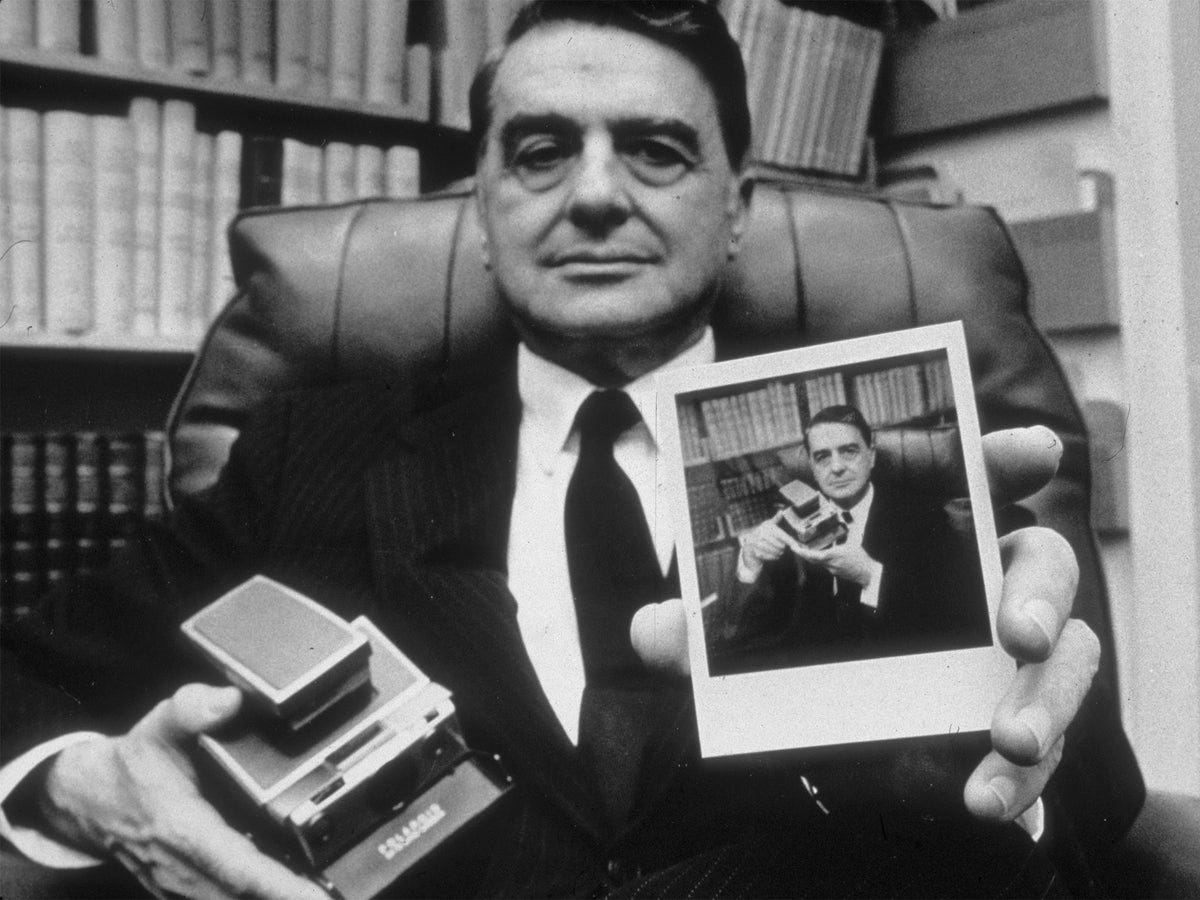
Edwin Land dropped out of Harvard as a freshman, moved to New York, and spent his nights sneaking into Columbia University’s laboratories to experiment with polarising light. By the time he was twenty-eight, he had founded the Polaroid Corporation - not to make cameras, but to make polarising filters. Sunglasses. Glare reduction for car windshields. Military goggles. The cameras came later, and they came because of an idea from his three-year-old daughter.
In 1943, on a family holiday in Santa Fe, Land took a photograph of his daughter Jennifer. She asked him why she couldn’t see the picture straight away. It was the kind of question only a child would ask - and only a certain kind of mind would take seriously. Land went for a walk. By the time he came back, he had solved the problem. Not vaguely. Specifically. The camera, the film, the physical chemistry. This was his genius. He said:
Within an hour, the solution to the problem had been pretty well formulated.
Except those few details that took from 1943 to 1973.
Those few details produced one of the most remarkable consumer products ever made. The first Polaroid Land Camera went on sale at a Boston department store before Christmas 1948. They made 57 units. All 57 sold on the first day. Over the next two decades, Land kept pushing - colour instant film in 1963, and then, in 1972, the thing he considered his life’s work: the SX-70.
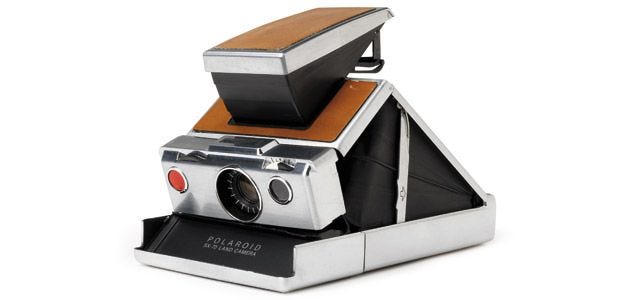
The SX-70 was a folding single-lens reflex camera that ejected a self-developing photograph. No peeling, no waiting, no waste. You pressed the button, the picture slid out, and it developed in your hand. Land had obsessed over every detail - the leather cover, the weight, the way it folded flat enough to fit in a jacket pocket. He wanted it to feel inevitable, as though no other design had ever been possible.
Sound familiar? Steve Jobs called Land one of the great inventors of the age, visited him in Cambridge in the 1980s, and modelled Apple’s product philosophy on what he’d seen at Polaroid. Both men were college dropouts. Both believed you should build things people didn’t yet know they needed. Both were pushed out of the companies they’d built. Edwin Land was your favourite entrepreneur’s favourite entrepreneur.
At its peak in the late 1970s, Polaroid held two-thirds of the instant camera market. It employed 21,000 people. Revenue would reach $3 billion whilst people were shooting a billion Polaroid photographs a year. Ansel Adams was a consultant. Andy Warhol used Polaroids obsessively - he loved the intimacy of them, the way you could shoot someone up close and see what you’d captured before they left the room. When Kodak tried to muscle in with its own instant camera in 1976, Polaroid sued and won $909 million in damages, the largest patent settlement in American history at the time.
It looked, from the outside, like a company that could not be beaten. It had the technology, the patents, the culture, the customers, and a founder who held 535 patents of his own. What it didn’t have was a plan for what came next.
Land stepped down as chairman in 1980. He left the company two years later, and died in 1991. He held 535 patents - more than any American except Thomas Edison. He never saw what happened next.
What happened next was a slow decline. Digital photography arrived, and Polaroid’s leadership couldn’t bring themselves to believe that people would stop wanting physical print. The company had actually invested in digital imaging early - by 1989, 42% of its R&D spending went on digital. But the executives couldn’t solve the business model problem. Polaroid’s economics depended on selling film. Cameras were the razor; film was the blade. Digital cameras didn’t need blades. The company made functional digital cameras as early as 1996. They never bet on them. Gary DiCamillo, the CEO from 1995 to 2001, later admitted the mistake: the entire leadership had believed in the permanence of the physical print, and they were wrong.
In October 2001, Polaroid filed for bankruptcy. Shares that had traded at $60 in 1997 were frozen on the New York Stock Exchange at 28 cents. The executives got $6.3 million in bonuses. The employees and retirees got nothing. Over the next seven years, the brand was sold, resold, and licensed to companies that slapped the Polaroid name on cheap televisions and DVD players. In 2007, the last Polaroid camera rolled off the line. In 2008, film production ceased entirely. The factory in Enschede - the last one standing - was scheduled for demolition. The machines would be scrapped. The chemical formulas had either expired or been banned under new environmental regulations. The handful of people who still knew how the process worked were about to scatter.
This is the moment Florian Kaps walked through the door.
He had been a Polaroid dealer for years and when the company announced the factory closure, he reacted in a way that baffled everyone around him. He didn’t mourn. He negotiated. For months he tried to persuade Polaroid’s management to let him save the production line. They told him repeatedly that it was impossible. The future was digital. Why was this crazy Austrian fighting for an outdated factory? At one point, Kaps offered a deal: fine, call it impossible, but give us the chance to try.
What happened next has the makings of a movie. During the negotiations, the FBI raided Polaroid’s parent company and jailed most of the senior management for fraud. In the chaos, Kaps found himself dealing with a sympathetic manager who had the authority to sign. The call came: you have ten days. If you can raise 180,000 euros, the factory is yours. He did. In October 2008, the Impossible Project bought what remained of the production machinery for $3.1 million, leased the north building of the Enschede plant, and hired a small team of former Polaroid employees — the people who still remembered how the machines worked.
Then they discovered the real problem. The machinery was only half the battle. Polaroid’s instant film was, as one of the team’s engineers put it, the most chemically complex man-made product ever created. Seventeen layers of polymers, dyes, reagents, and timing chemicals in a sandwich two millimetres thick, with an infinite number of possible reactions between them. The original formulas no longer existed and the custom chemicals that Polaroid had used were no longer manufactured. The supply chains had been dismantled years earlier. They couldn’t copy what Polaroid had made. They had to invent something new that would work in the same cameras.
The first film - PX 100 Silver Shade - went on sale in 2010. It was, by any assessment, terrible. Images took over an hour to develop. The chemicals leaked through the seals. Light destroyed the picture if you didn’t shield it immediately after it ejected from the camera. Humidity ate the image from the inside out. Photographers who had been watching the project’s countdown timer with hope bought packs at $24 for eight shots and came back with blurs and smears.
They shipped it anyway. And people bought it anyway.
That fact alone tells you something about what Polaroid meant. The product barely worked, and the community didn’t care - or more accurately, they cared enough to keep buying, keep testing, keep feeding back, because they understood what was happening. This wasn’t a consumer product launch. It was a rescue operation, and the customers were part of the crew.
Over the next few years, the film improved. Slowly, painfully, generation by generation. Colour came. Stability came. Development times dropped from an hour to minutes. Meanwhile, a young Polish-born investor named Oskar Smolokowski - who had been following the project since his days at Imperial College London - got involved. His father, Wiaczesław Smolokowski, became the largest shareholder. In May 2017, the family acquired what remained of the Polaroid brand and intellectual property outright. For the first time since the bankruptcy, the factory and the name were under the same roof.
The Impossible Project became Polaroid Originals in 2017, and then, in March 2020, simply Polaroid. The name came home.
No one involved in rescuing Polaroid will ever get rich because of it. Polaroid will never return to the heights or the size it was in the 70s and 80s, and that’s OK. This wasn't a turnaround for turnarounds sake, or at the bequest of a group of shareholders or activist investors. This is a love story…
…and who can argue with that.
The Lessons
Lesson 1: Success doesn’t always look the same
Second Acts is about telling stories of companies that came back bigger, stronger, more profitable than before. Rolls-Royce rebuilt itself into one of the world’s great engineering companies. Old Spice went from your grandfather’s aftershave to a billion-dollar brand. Delta climbed out of bankruptcy and became the most profitable airline on earth.
Polaroid didn’t do anything like that. The original company had $3 billion in revenue, 21,000 employees, and two-thirds of the instant camera market. What came back is a niche film brand, made in a single factory in the Netherlands by a small team of people who love the product. By any conventional measure of corporate turnaround, the scale doesn’t match.
But that’s the wrong measure. Polaroid film exists again. People are shooting it, framing it, giving it to each other. The white border and the chemical smell and the sixty seconds of watching an image appear from nothing- all of that is back in the world because a handful of people decided it should be. Not every Second Act needs to be a blockbuster. Sometimes the understated ones matter just as much.
Lesson 2: The things that make a company great are often the things you can’t see
When Polaroid closed its last factory, the machines were the obvious asset. The Impossible Project bought them. But machines without knowledge are just metal. The real value was invisible.
Instant film is seventeen layers of chemistry in a sandwich two millimetres thick. The formulas had expired. The custom chemicals had stopped being manufactured. The supply chains had been dismantled. And the understanding of how all of it worked together - the sequencing, the timing, the feel of it - lived in the heads of a handful of engineers who were weeks away from moving on with their lives.
Every company has its version of this. The process that isn’t written down. The supplier relationship that only one person manages. The institutional memory that nobody thinks to protect because it just sits there making everything work. You don’t see it or value it. And then one day the factory closes and you realise it’s gone - and rebuilding it from scratch takes years of pain and leaked chemicals and photographs that come out wrong.
Lesson 3: Some things only happen because someone decides they should
There was no business case for the Impossible Project. The market had moved on. Digital photography had won. The economics of manufacturing instant film in a single Dutch factory for a niche audience of analogue obsessives made no sense. Every spreadsheet said the same thing - let it go.
Florian Kaps didn’t have a spreadsheet. He had a conviction that Polaroid film was worth saving, not because of what it could earn, but because of what it was. And that conviction turned out to be enough. Not enough to build a $3 billion company. But enough to buy the machines, hire the engineers, reinvent the chemistry, and put instant film back into the world.
Business schools don’t teach this. They teach strategy, positioning, competitive advantage. They don’t teach the moment where someone looks at a thing that’s about to be destroyed and says: no. Not this one. And then does something about it. But that’s how this story happened. And it’s worth remembering, because not everything that deserves to exist will survive on its own. Sometimes it needs someone to decide.
What a cool story. Thank you for the painstaking research and details.
This is so interesting and inspiring! Gotta love everything about Polaroid. Always have, always will. You gave me more reasons!