
Rolls-Royce - The Burning Platform
How Tufan Erginbilgiç saved the British giant by saying what nobody wanted to hear

Welcome to this edition of Second Acts. Another story of a business turnaround or transformation and the lessons within.
This week, Rolls-Royce.
Tufan Erginbilgiç was standing at King’s Cross station in London, a day after he had given his first company-wide address as the CEO of Rolls-Royce, when a woman approached him.
“Your speech yesterday,” she told him. “It was so inspiring.”
This woman, it turned out, worked in turbine manufacturing at Rolls-Royce.
The day before, her new CEO had told her that her company was a burning platform. That she and her 42,000 colleagues were working for a company that was underperforming every competitor. That investors had lost faith. That this was, effectively, the last chance saloon.
But rather than frightened, she was inspired.
That story tells you everything about what kind of turnaround this was going to be, and the kind of leader Tufan Erginbilgiç is.
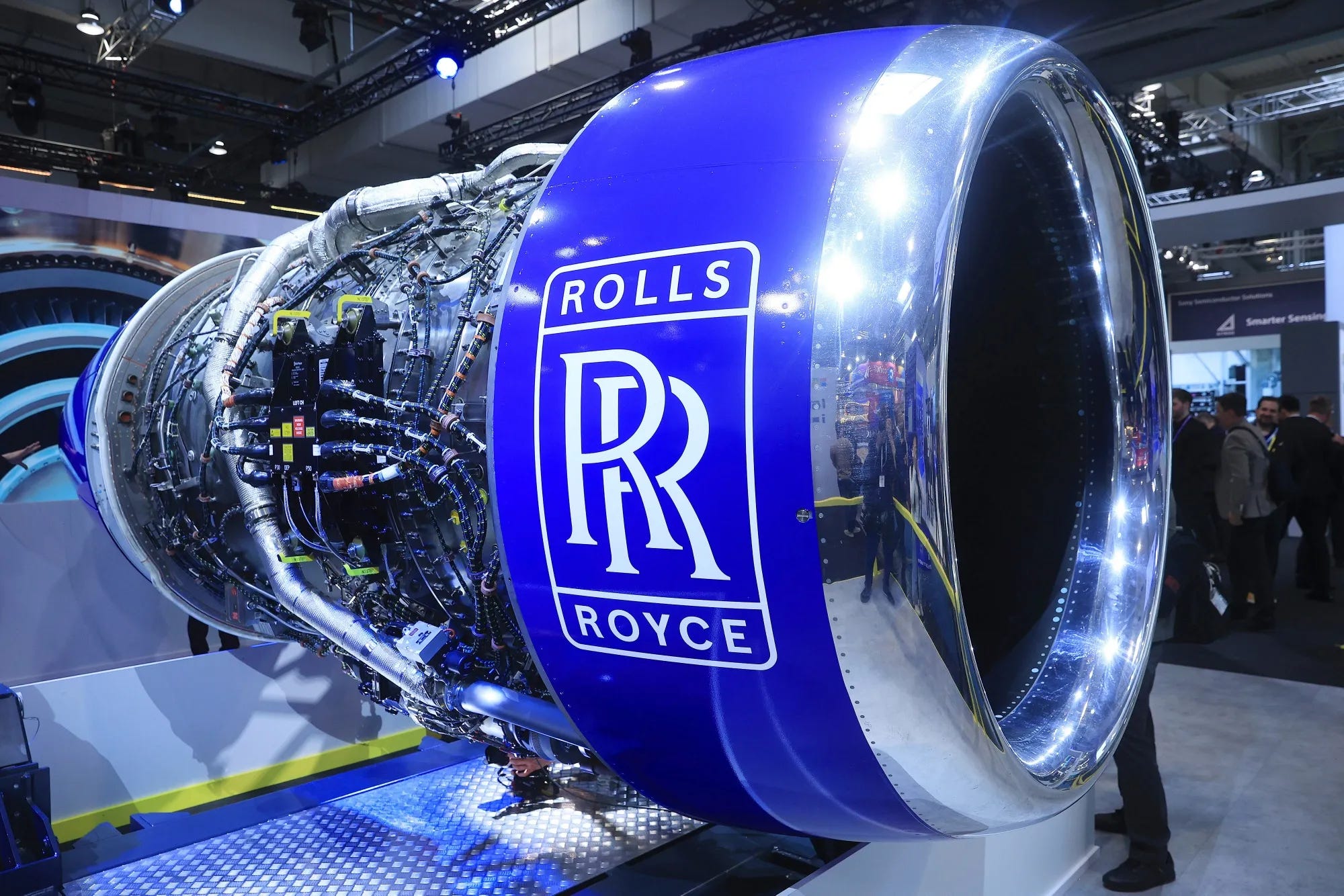
First, a quick note on the history. Rolls-Royce does not make cars. The iconic grille, the luxury saloons that carry VIPs — those belong to a completely separate company, Rolls-Royce Motor Cars, owned by BMW since 2003. The split actually contains the story of one of the more extraordinary corporate episodes of the late 1990s, when Vickers, the British conglomerate that owned the car business, sold it to Volkswagen for £430 million. What Volkswagen failed to notice was that the Rolls-Royce name and logo were not theirs to buy — they were owned by Rolls-Royce plc, the aero-engine maker, which promptly licensed them to BMW for a mere £40 million. VW got the factories and the workforce. BMW got the name. The cars and the engines have been separate businesses ever since.
The Rolls-Royce that Erginbilgiç took charge of is an engineering company, headquartered in Derby, England, that makes the engines powering the world’s widebody aircraft - A350s, 787s - the kind you board for long-haul flights.
The business model is built around a basic concept: sell the engine, then get paid every time it flies. Under long-term service agreements, airlines effectively pay Rolls-Royce by the hour for as long as the engine is in the air, covering maintenance, repairs and overhauls. It is a model that generates highly predictable, recurring revenue — as long as planes keep flying. When they don’t, the consequences are severe.
Which is exactly what happened.
When COVID grounded global flights overnight in 2020, engine flying hours collapsed to around 40% of pre-pandemic levels and the cashflows that underpinned the entire business model essentially stopped. Rolls-Royce burned through billions in emergency liquidity, took on enormous debt, and suspended its dividend for the first time in decades. By the time Erginbilgiç arrived in January 2023, the company was sitting on £3.8 billion in net debt, its share price had been decimated, and it had spent the better part of three years in survival mode rather than genuine recovery. His predecessor had already cut over 9,000 jobs and delivered more than £1 billion in cost savings — so on the surface, the argument could be made that the hard work was done and the tide was turning.
Erginbilgiç took one look and disagreed.
The company was still losing ground to every key competitor, contracts had been signed on terms that destroyed value, and a cost-to-gross-margin ratio so tight that a 10% fall in gross margin would tip the business into the red. This wasn’t a recovering business. It was, in his words, a burning platform.
When new CEOs arrive, they tend to follow a predictable script. They praise the talent of the organisation, acknowledge the challenges ahead, and set out a vision for the future. They are careful, measured, and reassuring.
Erginbilgiç did the opposite.
It was a calculated risk. He later admitted as much: “If you’re not careful when you put the mirror up, you may scare people.” But he didn’t just hold the mirror up — in the same breath, he told them where he intended to take the company and why he believed it was possible. The burning platform wasn’t the destination. It was the starting point.
To understand why that landed so well, you have to appreciate what Rolls-Royce employees had lived through in the years prior. This was not a company that had been standing still. There had been restructuring programmes, job cuts, cost reduction targets — round after round of painful change that had consumed enormous energy without fundamentally shifting the company’s trajectory. It was clear that something fundamentally wasn’t right. What they hadn’t had was a leader willing to say it plainly, and to make a clear distinction between what had come before and what was coming next.
There’s a big difference between restructuring and transformation, Erginbilgiç believes:
Transformation, to my mind, is more ambitious. It’s taking the company from point A to point B, where getting to point B opens more potential for the company.
Restructuring tidies up the present. Transformation bets on a different future. And you can only mobilise people around that bet if they understand, honestly, why the present is no longer acceptable.
The Four Pillars
Transformations don’t happen by being a cowboy.
Erginbilgiç built his approach around four pillars.
The first was holding up the mirror — making the reality of the company’s position unmistakably clear to every employee, backed by data he had spent months gathering before he even started the job. From September 2022, before he had officially taken the helm, he was already speaking to shareholders, visiting sites, and commissioning external benchmarking against competitors. By the time he walked through the door in January 2023, he knew exactly what he was dealing with. The burning platform speech was a conclusion from months of analysis.
The second was strategy — but not as most organisations understand it. Rather than developing it in what he calls “a dark room with consultants,” Erginbilgiç ran workshops with around 500 employees to brainstorm options and decide on the best path forward. The logic was simple: the people closest to the business often understand it better than a new CEO, and a strategy built with that breadth of input arrives pre-aligned. Rolls-Royce emerged with 17 clear strategic initiatives, cascaded down through the organisation so that every person could see their role. “If you don’t have a strategy that can cascade down to 42,000 people,” he has said, “it won’t get delivered.”
The third pillar was performance management — clear targets that flowed directly from the strategy, tracked relentlessly, with nowhere to hide. One of the 17 initiatives, for instance, focused specifically on improving “time on wing” of its large engines — the longer an engine stays in the air rather than on the ground being serviced, the more money Rolls-Royce earns. Every initiative had that same clarity of purpose and ownership.
The fourth was pace and intensity. He shed 2,500 roles, primarily in middle management. He introduced zero-based budgeting to replace institutional rigidity. He renegotiated contracts and walked away from deals that didn’t generate fair returns, on the basis that short-term volume wasn’t worth long-term value destruction. “If you don’t put scores on the board quickly, you will lose people,” he has said. “When you continue to deliver, suddenly more and more people believe.” And underpinning all of it was a philosophy he was clear about from the start: “Everything has a purpose here. Transformations don’t happen by being a cowboy.”
The results were not subtle
In his first full year, underlying operating profit rose 144% from £652 million to £1.6 billion — well ahead of guidance and analyst expectations. A year later, that figure had surged a further 57% to a record £2.5 billion. Revenue rose 16% to £17.85 billion. Engine flying hours, the lifeblood metric of the business, recovered to 103% of pre-pandemic levels. Operating margins in civil aerospace hit 16.6%, up from just 2.5% when he arrived.
The balance sheet transformation was equally dramatic. A company carrying £3.8 billion in net debt when Erginbilgiç arrived ended 2024 with £475 million in net cash — a swing of more than £4 billion in two years. The dividend was reinstated. A £1 billion share buyback was launched. Profit targets set for 2027 were hit two years early.
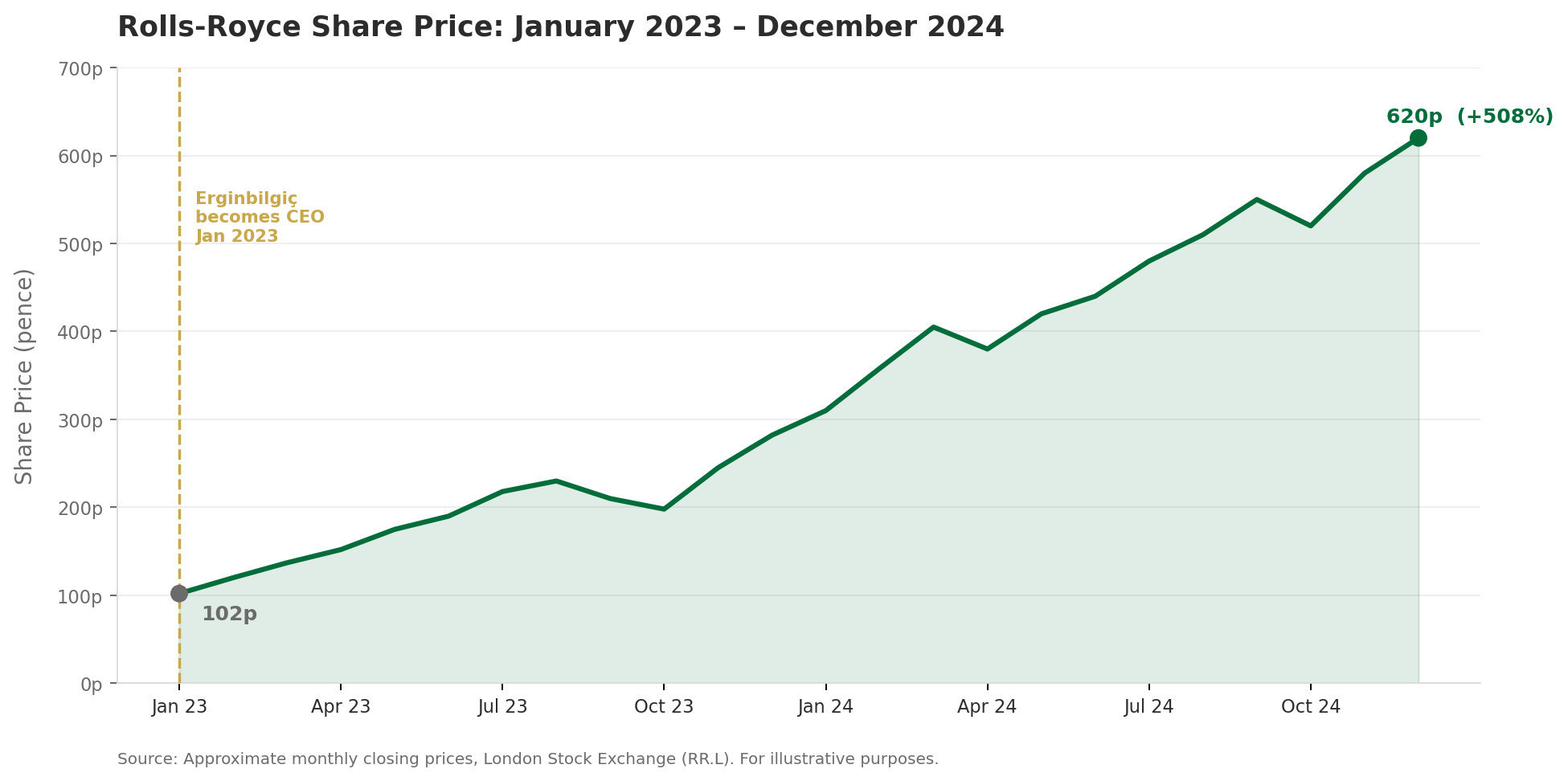
And the share price? From the lows of early 2023 to the end of 2024, it had risen more than 600%. Rolls-Royce added over £70 billion in market value in two years.
Truly one of the most remarkable corporate recoveries in British business history.
Conclusion: The Lessons
The results at Rolls-Royce are extraordinary. But what makes this story worth studying isn’t the numbers — it’s the thinking behind them. Three lessons stand out:
1. Inspiration is not enough - Erginbilgiç could have delivered that burning platform speech and had nothing to show for it six months later. The woman at King’s Cross was inspired — but inspiration is fragile. What converted it into genuine belief, across 42,000 people, was the scoreboard. Profit up 144% in year one. Cash flow turning. The dividend returning. “If you don’t put scores on the board quickly, you will lose people,” he has said. “When you continue to deliver, suddenly more and more people believe.” Leaders who rely on vision without early delivery don’t transform organisations — they just delay the disappointment.
2. Transformation has to mean something, or it’s just restructuring with better branding. Rolls-Royce had been through restructuring programmes before Erginbilgiç arrived. Jobs had been cut. Costs had been reduced. And yet the company was still losing ground to every competitor. The difference this time wasn’t the actions — many of them were similar — it was the destination. Erginbilgiç was explicit from day one that the goal wasn’t to tidy up the present, it was to build a fundamentally different company. Without that vision, the painful decisions look like more of the same. With it, they have a purpose. Transformation without a compelling point B is just pain.
3. Clarity is non-negotiable. Seventeen strategic initiatives. Four behaviours. A single ratio — total cost to gross margin — that told the whole organisation whether it was winning or losing. Erginbilgiç understood that a strategy which can’t be understood by the person on the factory floor isn’t a strategy at all. “If you don’t have a strategy that can cascade down to 42,000 people,” he has said, “it won’t get delivered.” In large organisations, ambiguity is the enemy of execution. The leaders who cut through it — who can make every person see their role — are the ones who actually deliver change.
The woman at King's Cross approached Erginbilgiç the morning after his speech — before a single target had been hit, before a single contract had been renegotiated. She was inspired not by results, but by the simple fact that her leader had told her the truth. That's where transformation begins. But as Erginbilgiç knew better than anyone, it's only where it begins. The discipline to prove it is what separates the leaders who inspire from the ones who actually deliver.
Sources:
https://www.ft.com/content/2995b431-496f-4497-b280-5604f753226c
https://www.mckinsey.com/capabilities/strategy-and-corporate-finance/our-insights/reinventing-rolls-royce-a-conversation-with-ceo-tufan-erginbilgic
https://fortune.com/europe/2025/06/04/rolls-royce-ceo-fired-managers-held-staff-brainstorms-turnaround-share-price-jump/
https://www.thetruthaboutcars.com/cars/features/abandoned-history-when-bmw-and-volkswagen-threw-hands-for-rolls-royce-and-bentley-45131935
This is a bit misleading, the vast majority of the share price performance was due to factors outside the CEO’s control. He helped but is just a small part of Rolls Royce miracle.
How do you unpack the effect of recovery of global air traffic? Seems to me he arrived at just the right time. Happens in my industry (mining) all the time when commodity prices 3x and surprise, surprise companies all start doing really well…